
Field Notes #3
Week of January 19, 2026
At the World Economic Forum in Davos this week, U.S. President Donald Trump unveiled what he called the “Gaza Board of Peace—a U.S.-led body that will oversee the second phase of the Israel-Palestine ceasefire agreement and, eventually, its reconstruction. The official 11-page charter makes no direct reference to Gaza at all, instead proposing a broad mandate as "a new international organization" seeking to "promote stability, restore dependable governance, and secure enduring peace in areas affected or threatened by conflict." Secretary of State Marco Rubio described it as a "new era" that could make an impact "beyond Gaza" and "serve as an example"–a thinly veiled attack on the United Nations, which Trump has attacked throughout both terms as ineffective and biased.
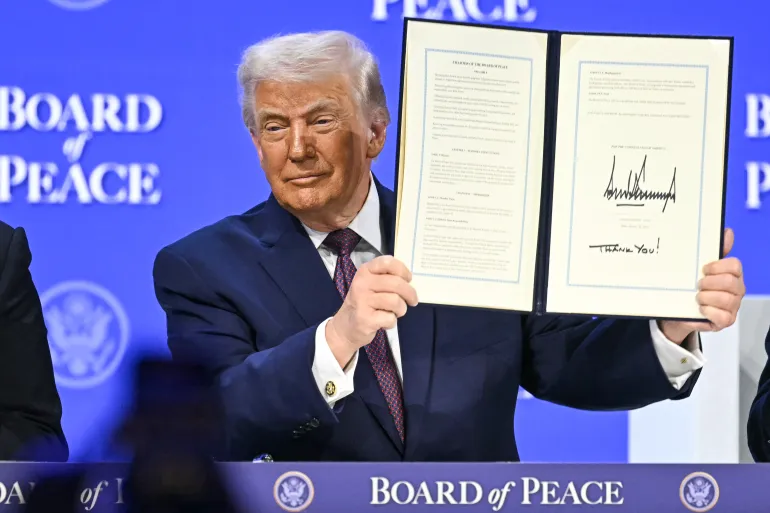
The membership reveals the agenda. Jared Kushner, son-in-law of President Trump and architect of the Abraham Accords, sits on the executive board alongside Steve Witkoff, a real estate mogul and Trump's Special Envoy to the Middle East. Tony Blair, longtime champion of the neoliberal rules based order, provides a veneer of international legitimacy. Representatives from Qatar, Egypt, and Turkey join them—regional powers with economic interests in Gaza's future. Twenty-five countries signed on as members on Jan. 22, including the UAE, Saudi Arabia, Pakistan, Indonesia, and Argentina. Notably absent: the U.K., France, Germany, Italy, Sweden, and Norway all declined to join, with Canada's Prime Minister Mark Carney's invitation getting revoked after accepting the offer in principle due to his refusal to commit $1 billion. Benjamin Netanyahu initially dismissed the board as "largely symbolic," then objected to the executive committee saying it "was not coordinated with Israel," before ultimately joining as a member.
According to the charter, Trump serves as chairman of the board for life with sole power to appoint and dismiss members, set agendas, and issue resolutions which essentially grants Trump veto powers over all decisions. Member states are granted three-year terms, however permanent membership will require a $1 billion contribution within the first year. Further, U.N. Security Council Resolution 2803 explicitly names President Donald J. Trump as chairman instead of the U.S. President, meaning that Trump will personally chair the board beyond his presidency through 2028–a clear indication that the board's central mission is receivership, not peacekeeping.
The unveiling of the board also marks the official close of the ceasefire’s first phase despite the ceasefire never functioning as agreed. It has been reported that Israel has violated the ceasefire agreement at least 1,300 times from Oct. 10, 2025, to today. Additionally, at least 422 Palestinians have been killed and 1,240 injured in the period since the ceasefire was announced, and aid continues to remain scarce. These are the operating conditions under which “Phase 2” will now proceed.
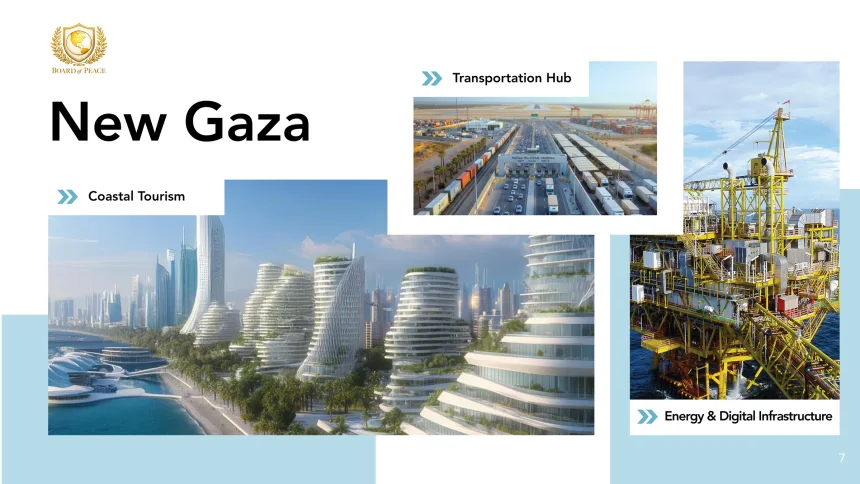
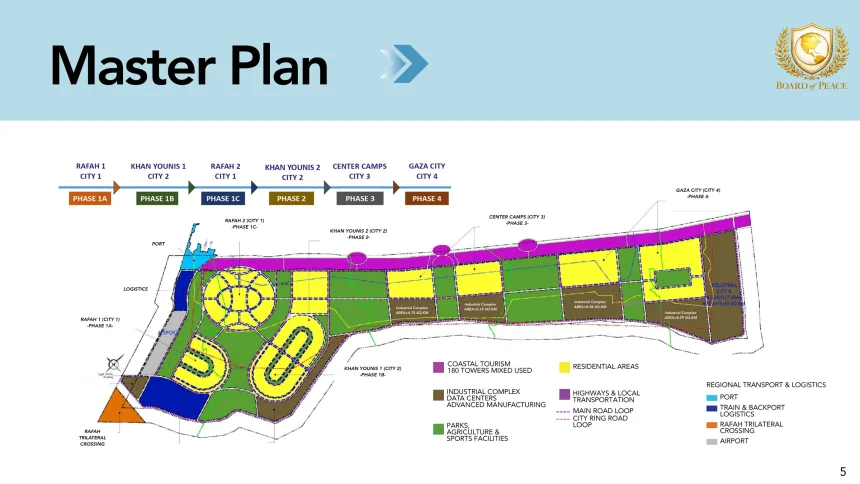
The Gaza Board of Peace serves as a governance structure masquerading as a mediation body. Its mandate is not to broker peace between sovereign states, but to manage reconstruction, oversee the distribution of aid, and determine Gaza’s political future. At the event in Davos, Kushner displayed mock-ups of high-rise buildings along Gaza’s shoreline proposing economic zones meant to promote coastal tourism and economic prosperity, suggesting that construction could begin in as little as two to three years. Reconstruction, when it finally does arrive, will almost certainly be contingent on security guarantees that favor Israel, political arrangements that exclude certain factions of Gaza’s political landscape, and economic structures that integrate Gaza into global markets all without a semblance of sovereignty.
The board's model for Palestinian involvement reveals how tightly controlled this "reconstruction" will be. A 15-member Palestinian technocratic committee headed by Ali Shaath, a former Palestinian Authority deputy minister, was appointed to administer Gaza on the ground. The technocratic committee was scheduled to take over civil affairs this week but was refused entry into Gaza via the Rafah Crossing. When a territory’s future is decided by an external board on which its people have no representation, and even appointed administrators are barred from entering the territory they’re meant to govern, one can only assume the board’s mission is less about self-determination and more so about administered occupation.
While Trump calls it a board of peace–a more honest name would be the Board of Permanent Control. Gaza’s ceasefire is over and its receivership has begun.
Also (At Davos) This Week...
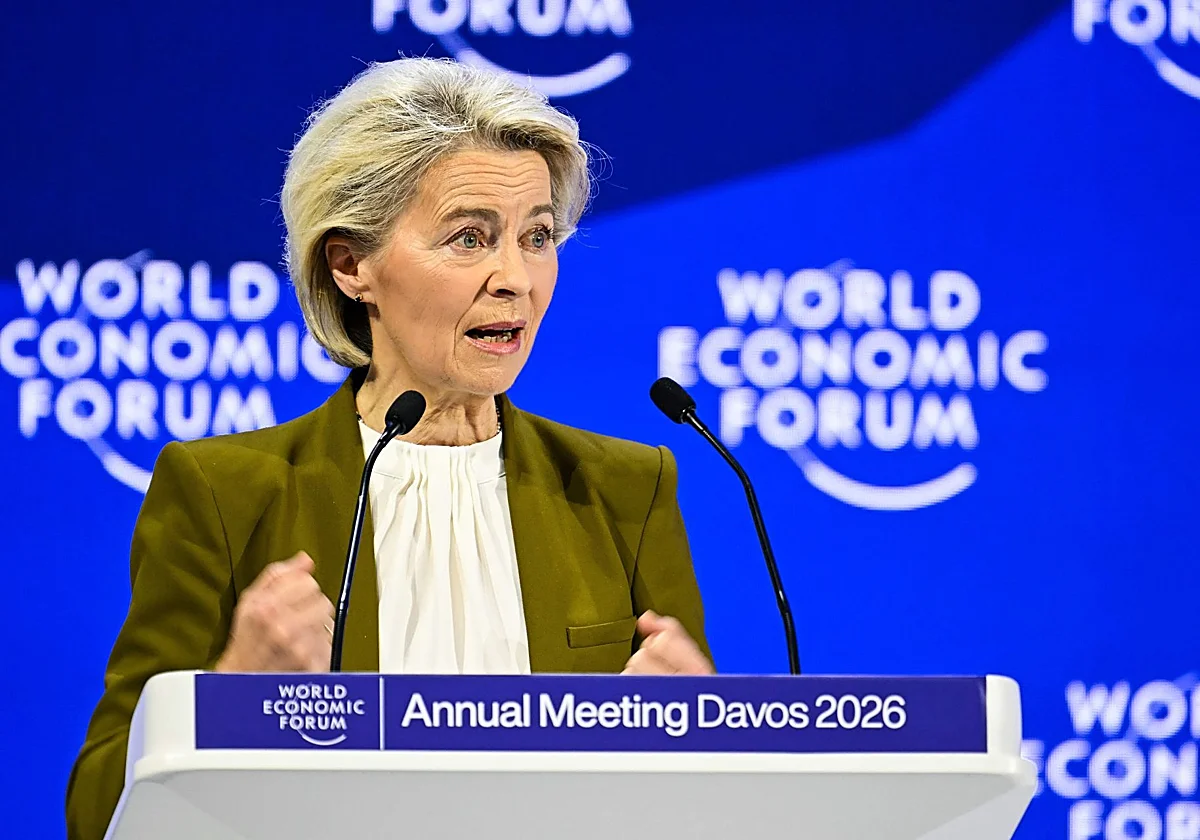
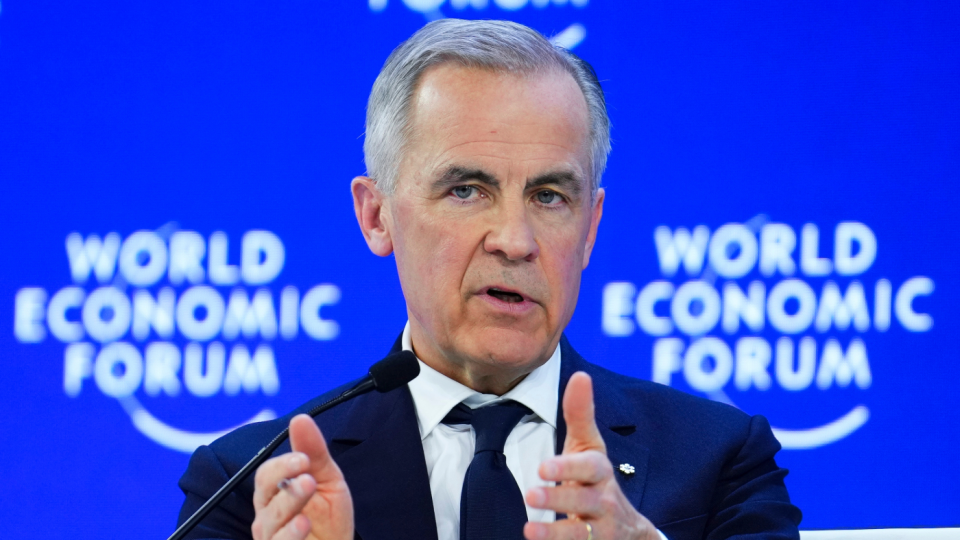
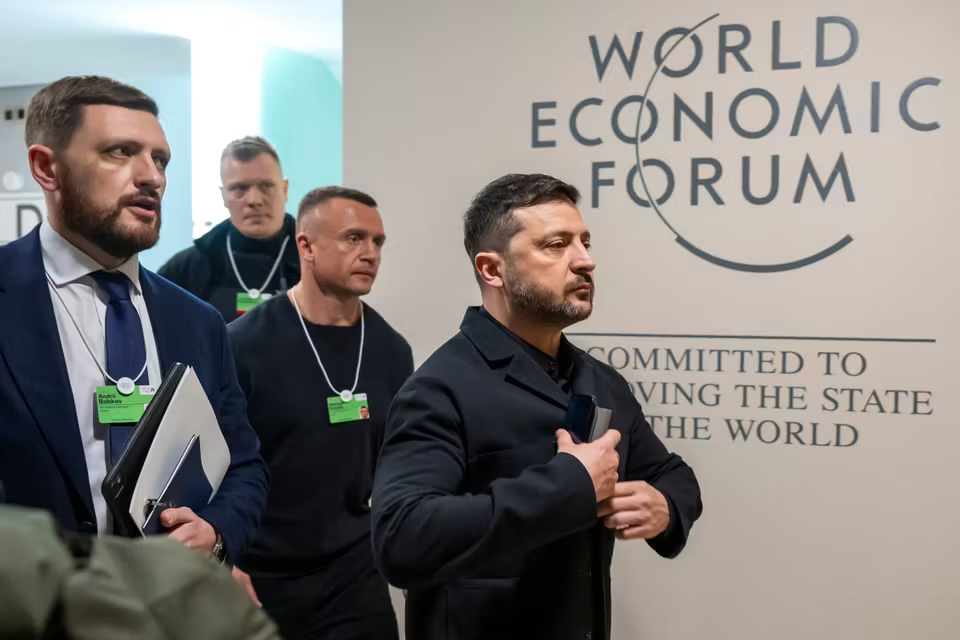
(Left) European Commission President Ursula von der Leyen, Canadian Prime Minister Mark Carney (Center), Ukrainian President Volodymyr Zelensky (Right).
At the World Economic Forum in Davos this week, a chorus of traditional U.S. allies delivered remarkably similar messages: the American-led international order is over, and it's time to build alternatives.
Canadian Prime Minister Mark Carney declared that the world is "in the midst of a rupture, not a transition" and that "the old order is not coming back." Carney urged middle powers to "stop invoking the 'rules-based international order' as though it still functions as advertised" and called it instead "a system of intensifying great power rivalry, where the most powerful pursue their interests, using economic integration as weapons, tariffs as leverage, financial infrastructure as coercion." Canada signed a strategic partnership with China last week and is pursuing trade deals with India, Thailand, the Philippines, and Mercosur–a radical pivot for a nation whose economy remains 67 percent dependent on U.S. trade.
French President Emmanuel Macron warned of the "brutalization of the world" and called for "more sovereignty and more autonomy for the Europeans," urging massive investments in defense, AI, and critical technologies to reduce dependence on the United States. European Commission President Ursula von der Leyen pushed for "an independent Europe," stating that "nostalgia will not bring the old order back" and warning that "if this change is permanent, then Europe must change permanently too."
Even Ukraine's Volodymyr Zelensky, whose political future is largely contingent on Western support, lashed out. "Instead of taking the lead in defending freedom worldwide, especially when America's focus shifts elsewhere, Europe looks lost trying to convince the U.S. president to change," Zelensky said. "Europe still feels more like geography, history, a tradition, not a real political force, not a great power."
The trigger was Trump, of course, his Greenland threats, tariff brinkmanship, and transactional approach to alliances. But the response reveals something deeper: U.S. allies no longer believe American hegemony is reliable enough to build strategies around. Carney framed it starkly: when middle powers "only negotiate bilaterally with a hegemon, we negotiate from weakness. This is not sovereignty. It is the performance of sovereignty while accepting subordination." What Davos made clear is that subordination is no longer acceptable—and alternatives, however uncertain, are being actively constructed.